A private hammam in Dubai costs AED 180,000 to 900,000 turnkey and takes twelve to twenty-four weeks, depending on whether you want a modern heated-slab room, a Turkish hammam with a dome and carved marble, or a Moroccan bath in tadelakt and zellige. It is the most architectural room in a home spa and the one with the most ways to go wrong, because it combines steam, heated stone, running water and waterproofing in one space. This page explains how we design and build hammams for villas in Dubai, Abu Dhabi and Sharjah.
Three hammams, three rituals
The room follows the ritual, so the first question we ask is what the family actually does in a hammam.
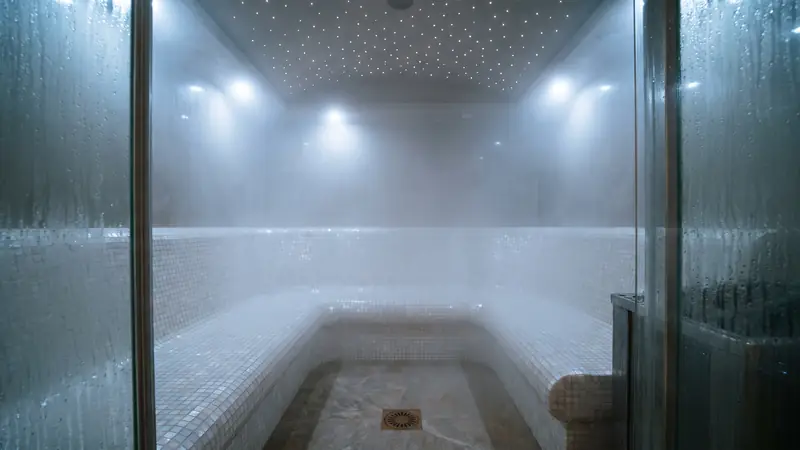
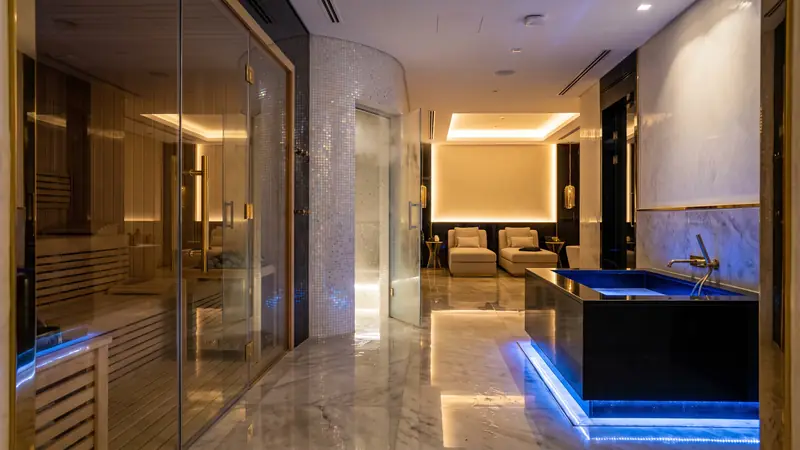
- Modern hammam. A heated central slab in cream travertine or book-matched marble, two or three brass basins with hot and cold taps, a steam system holding 42 to 45 °C at high humidity, a sloped or barrel ceiling with a starlight field, quiet lighting. This is the version most villa owners in Dubai Hills Estate, Al Barari and Jumeirah choose: a room for the family every evening and for guests at the weekend.
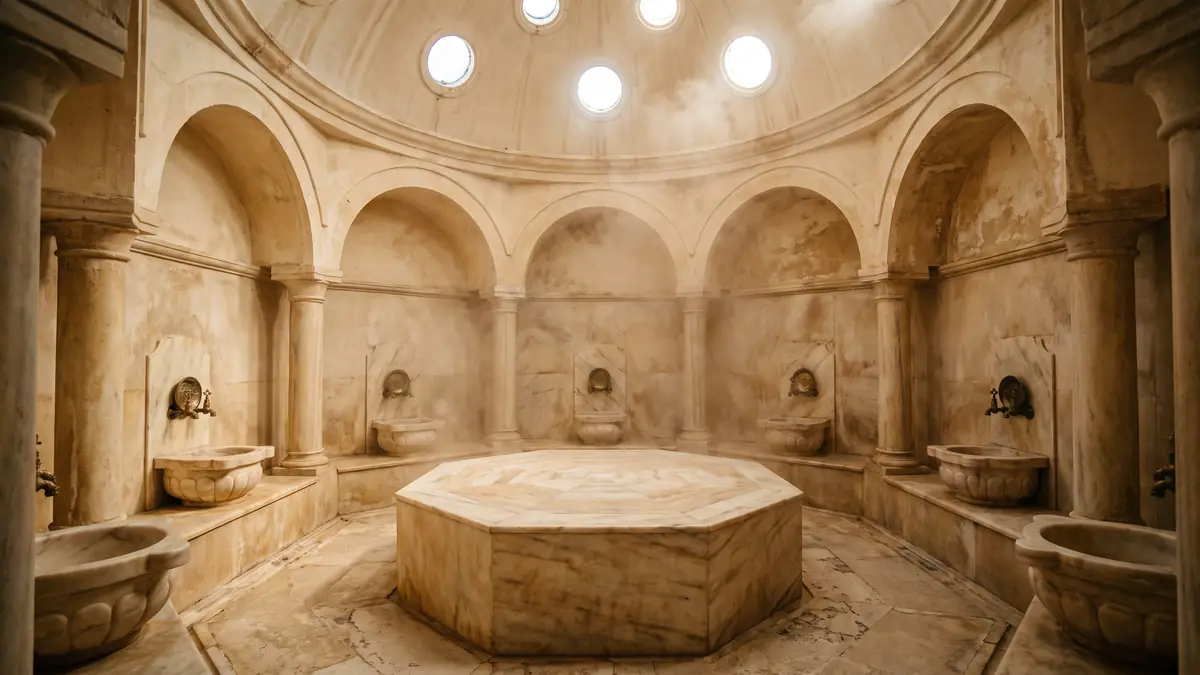
- Turkish hammam. A large octagonal or round göbek taşı under a dome with glass oculi, kurna basins carved from marble along the walls, a sıcaklık main room and often a smaller warm room. Built for the full ritual: heat, kese scrub, foam massage on the stone. Emirates Hills, Palm Jumeirah and Abu Dhabi clients with a family tradition of the hammam tend to choose this register.
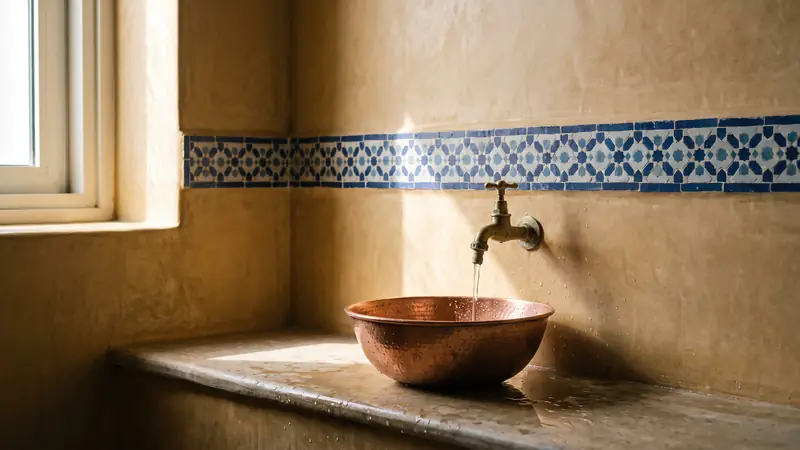
- Moroccan bath. A warm, humid room finished in ochre or grey tadelakt, bands of zellige tile, arched niches, a low heated bench and a brass basin, with a lower steam level than the Turkish room. Built around black soap, the kessa glove and rhassoul clay. Sharjah and Abu Dhabi villas ask for this most.
The hammam design guide describes each ritual and the architectural consequences in detail.
Recent hammams in Dubai
In 2025 we built a villa hammam in Emirates Hills, and in 2026 an onyx hammam in Nad Al Sheba. At a larger scale, our crew delivered the thermal section of a wellness resort in Riyadh that includes a 22.4 m² hammam. Marble and mosaic for our hammams are made in our own factory in Istanbul, where we have manufactured spa rooms since 1987, and slabs and basins are laid out and checked there before they are crated for the site, so nothing is discovered to be the wrong size on the day it arrives.
What is in the price
| Register | Room size | Slab | Steam | Indicative turnkey range (AED) |
|---|---|---|---|---|
| Modern hammam | 3.0 × 3.0 m | 1.6 × 1.2 m heated slab | 12 kW generator | 180,000 – 300,000 |
| Modern hammam, large | 4.0 × 3.5 m | 2.0 × 1.6 m slab, heated bench | 15 kW generator | 300,000 – 450,000 |
| Moroccan bath | 3.0 × 3.0 m | heated bench, tadelakt, zellige | 9–12 kW generator | 260,000 – 480,000 |
| Turkish hammam with dome | 4.5 × 4.5 m+ | octagonal göbek taşı 2.4 m | 15–18 kW generator | 350,000 – 900,000 |
Every band includes the design set and 3D visualisation, waterproofing and drainage, slab heating with controls, the steam generator with aroma dosing, stone or plaster finishes, basins and brassware, lighting, the glass door, DEWA or ADDC submissions for both circuits, and commissioning with a 24-month warranty. In an existing villa, any builder’s work needed to form the shell is priced separately once we have seen the room.
The heated slab, done properly
The göbek taşı is what makes a hammam a hammam. It has to be warm, not hot, across its whole surface, and it has to stay that way for twenty years without a crack. We build it in layers: a waterproofed concrete base, 50 mm of insulation, a screed with electric heating mats or hydronic pipes at 150 mm centres, a floor sensor, then 30 mm of honed marble with movement joints at the edges and a rounded arris so it is comfortable to lie on. The slab runs at 38 to 42 °C on its own circuit, controlled separately from the room. Where the client wants a heated bench as well, the same build-up runs up the wall behind it.
Steam, ventilation and the dome
A hammam is warmer and wetter than a sauna, cooler and wetter than a steam room: 40 to 45 °C at 60 to 90 % humidity, with the stone doing most of the warming. The steam generator is sized for the room volume and the amount of exposed stone, which absorbs heat; a 4 × 3.5 m marble hammam needs a 15 kW unit where a tiled steam room of the same size would need 12. Ventilation is a filtered make-up air inlet low on the wall and a mechanical extract that runs after use, so the room dries overnight and the marble does not spot. Domes are built in reinforced plaster or GRC over a steel frame, with glass oculi that bring daylight down in points, and are finished inside with the same waterproof system as the walls. In rooms under 2.8 m we build a barrel vault or a sloped ceiling with a fibre-optic field instead.
Waterproofing that treats the hammam as a pool
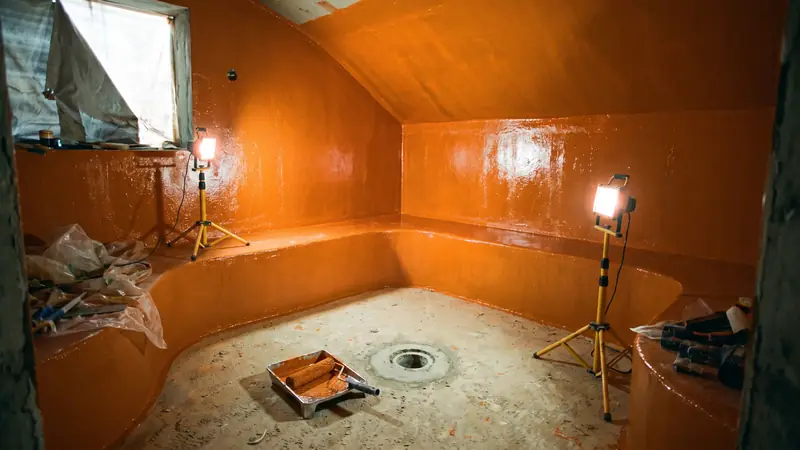
Everything in a hammam is a penetration through the waterproofing: slab heating cables, basin taps, the steam outlet, drains, lights. We tank the whole shell in cementitious waterproofing, apply a bonded membrane over it, seal every penetration with a flange, and flood-test the room for 48 hours before any screed or stone goes in. The same discipline is on our steam room page, and the waterproofing mistakes article shows what happens when it is skipped.
Power and approvals
A hammam has two significant loads: the steam generator, 9 to 18 kW on three-phase, and the slab heating, 2 to 5 kW. Both go on dedicated circuits and both are part of the DEWA load-change submission, prepared by our registered consultant with a single-line diagram and a load calculation. In Abu Dhabi the submission goes to ADDC, in Sharjah to SEWA. The process is described on our DEWA approval page. In master communities the wet-works and the changes to drainage also need a community NOC, which we file with the design set.
Stone, plaster and brass
For the modern hammam we use cream travertine, Thassos or a book-matched grey marble, honed rather than polished so it is safe wet. For the Turkish hammam, Marmara or Afyon white marble with carved kurna basins. For the Moroccan bath, tadelakt lime plaster applied by hand and polished with olive soap, bands of hand-cut zellige, and brass or copper basins. All brassware is solid brass with a lacquer-free finish that develops a patina; chrome does not belong in a hammam.
Twelve to twenty-four weeks
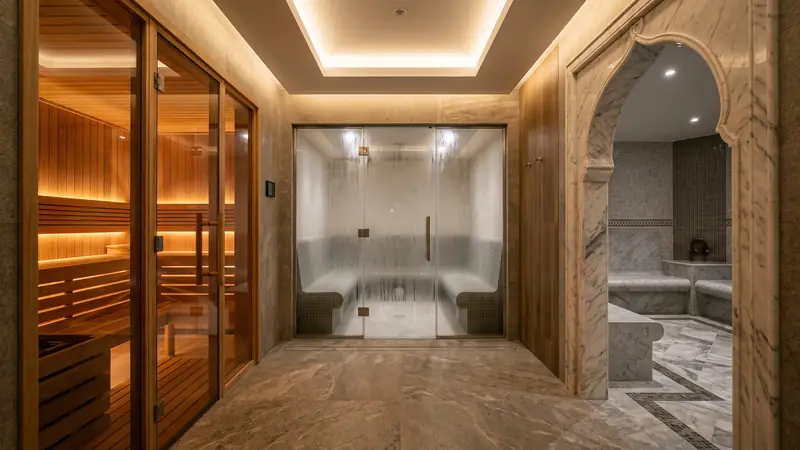
Three to four weeks of design, visualisation, approvals and the NOC. Six to ten weeks for the stone, basins, dome components and the generator. Three to six weeks on site in strict order: tanking and membrane, flood test, drainage and screed, slab heating, stone, plaster or tile, dome finishes, brassware, glass, generator and controls, commissioning with you in the room. Payment terms and the full step list are on the process page. The hammam is usually the centrepiece of a larger villa wellness suite with a sauna and a cold plunge on either side, and we design the three together so the plant room and the drainage are planned once.
Message us on WhatsApp with a photo of the room you have in mind, or the plan of a villa under construction, and tell us which of the three hammams the family would use. We will send photos of finished hammams like it; the size, the ceiling options and a first budget follow from a project manager within one working day.