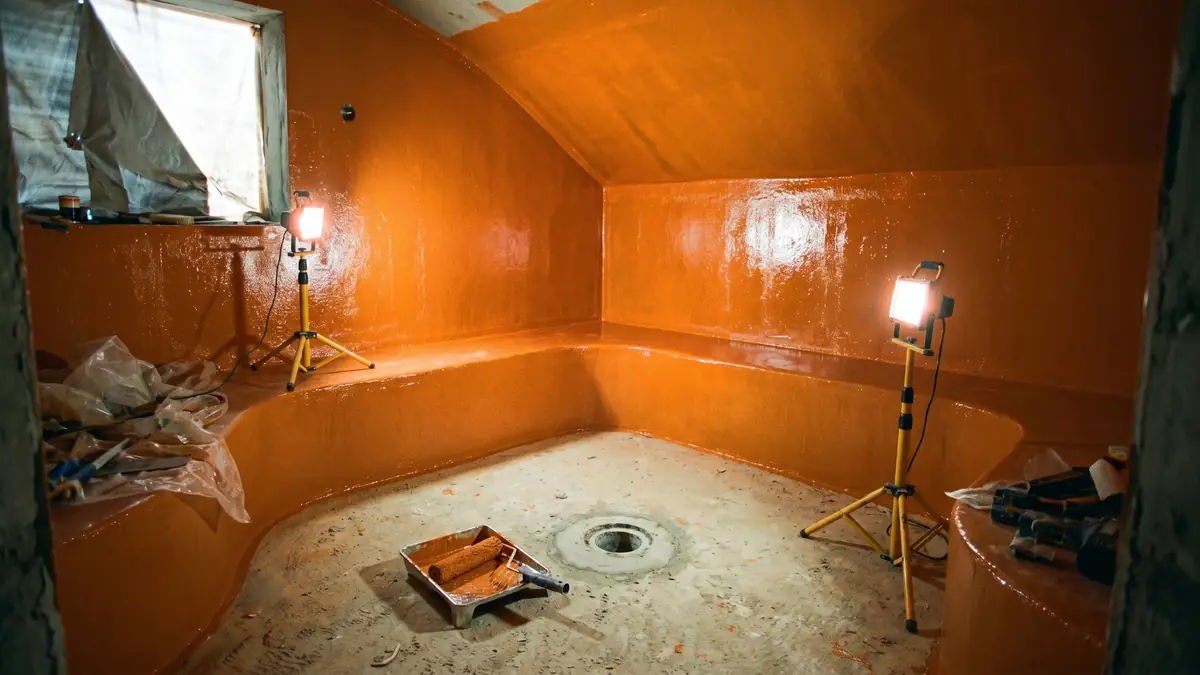
Most steam rooms that fail in Dubai fail within three years, and they fail for one of seven reasons, all of them decided in the first week of construction. We see them on repair calls across the city, in villas in Jumeirah and Arabian Ranches and in hotel spas alike, and this article lists them, what each looks like two years later, and which ones can be fixed without taking the room apart. The construction we use to avoid them is on the steam room page.
1. The waterproofing stopped at the tiles
The most common and the most expensive. A tiled shower with a generator added is not a steam room: tile and grout are not waterproof, and steam finds the joints within months. Two years later the wall behind the tiles is wet, the adjoining room smells musty and the skirting outside is swollen. The only repair is to strip the finishes and tank the room properly: cementitious waterproofing on every surface, a bonded membrane over it, flanged seals at every penetration.
2. The ceiling is flat
Condensation forms on every surface of a steam room. On a flat ceiling it collects into drops and falls; on a ceiling sloped at 10 to 15 degrees it runs to the walls and down to the drain. A flat-ceiling steam room drips on the user, and the drips carry the ceiling’s grout with them. Repair is possible where the room has height to spare: a new sloped substrate under the existing ceiling, waterproofed and tiled.
3. Penetrations were never sealed
The steam outlet, the light, the temperature probe, the drain and the aroma nozzle all pass through the waterproofing. Each needs a flanged seal bonded to the membrane. Where they were simply cut through, water tracks along the pipe or the cable into the wall, and the fault shows as a damp patch on the other side of the wall, exactly at the height of the outlet. This one is repairable: the fitting is removed, the membrane is patched with a flange and the fitting reinstated.
4. Nobody flood-tested the room
A tanked room is filled to the top of the upstand and left for 48 hours before a single tile goes on; the water level is checked and the rooms around are inspected. Skipping it means the first flood test is the client’s first session. There is no repair for a missing test, only the diagnosis of whichever of the other six mistakes it would have caught.
5. The floor falls the wrong way
A steam room floor needs a 1:60 fall from every corner to the drain and a threshold that keeps water in the room. Where the fall is wrong, water pools at the bench, the grout darkens and the room smells; where the threshold is missing, the corridor floor is wet after every session. Falls can be corrected with a new screed and tiles if the waterproofing under them is sound.
6. The generator was never descaled
Dubai water scales generator elements and cylinders. A generator without automatic drain cycles and without descaling every six to twelve months fails in eighteen months to three years: it takes longer and longer to produce steam and then trips. This is not a waterproofing fault but it is the fault most often reported as one, because the room stops working. Repair is a descaling and, where the elements are gone, a new generator with a scale filter and automatic drain, as on the maintenance page.
7. There is no extract
A steam room without a mechanical extract that runs after the session stays wet overnight. The grout darkens, silicone goes black, the door seal grows mould and the room smells within a year. Adding an extract is straightforward where there is a duct route; it is the cheapest of the seven repairs and the one that most often saves a room that seemed lost.
How we diagnose
A visit with a moisture meter, a thermal camera and a look at the plant cupboard. Damp behind tiles at bench height with a dry corridor: penetrations or grout. Damp in the adjoining room at outlet height: a penetration. Wet skirting outside the door: the threshold or the falls. A musty room with clean walls: the extract. A room that will not fill: the generator. A wet room on the floor below: the membrane, and a rebuild. Every diagnosis is written up with photos before any repair is quoted.
The construction that avoids all seven
Cementitious tanking on every surface, a bonded membrane over it, flanged seals at every penetration, a 48-hour flood test, a ceiling sloped at 10 to 15 degrees or a barrel vault, floor falls of 1:60 to a central drain, a threshold, a generator with automatic drain and a scale filter, and an extract that runs twenty minutes after every session. It is the same discipline for a hammam, where the heated slab adds its own penetrations, and the hammam design guide describes the slab build-up.
Send photos of the room, the plant cupboard and any damp patches outside it. A technician will reply with the likely fault and what the diagnostic visit involves.