A sauna heater or a steam generator above about 4.5 kW is a change to your villa’s electrical load, and in Dubai a change of load goes to DEWA through a registered consultant with a single-line diagram and a load calculation. It takes two to four weeks when the villa has spare capacity and it runs in parallel with manufacturing, so it rarely delays a project. This article explains what is submitted, who submits it, what the community NOC adds and what happens when the supply is full.
When approval is needed, and when it is not
| Equipment | Typical load | Circuit | DEWA submission |
|---|---|---|---|
| Infrared cabin, 1–2 persons | 1.7–2.4 kW | dedicated 16 A socket circuit | not required |
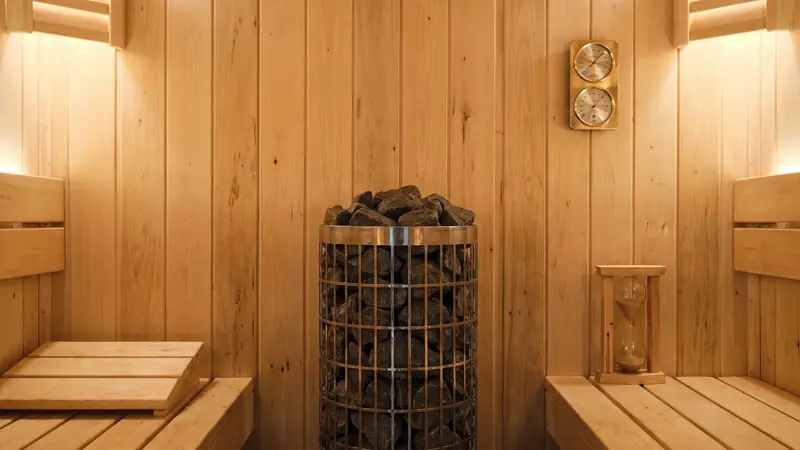
| Compact sauna heater | 4.5 kW | dedicated single-phase circuit | usually required |
| Villa sauna heater | 6–12 kW | dedicated three-phase circuit | required |
| Steam generator | 6–15 kW | dedicated three-phase circuit | required |
| Plunge chiller | 1.2–2.4 kW | dedicated single-phase circuit | included when built with a heater |
| Snow room refrigeration | 5–9 kW | dedicated three-phase circuit | required |
The threshold is not a magic number; it is whether the new circuit changes the load DEWA has on record for the property. In practice, a traditional sauna or a steam room always does, and an infrared cabin never does.
Who submits, and what
DEWA accepts electrical submissions from registered consultants and contractors, not from homeowners. Our consultant prepares three documents:
- A single-line diagram showing the main incomer, the DB board, the new dedicated circuit with its breaker rating, the cable type and size, the RCD and the isolator outside the sauna, and the equipment.
- A load calculation listing the villa’s existing connected load and the new equipment, showing that the total stays within the supply rating with diversity applied.
- The equipment data: the manufacturer’s data sheet for the heater or generator, with its certification.
These go through the DEWA portal as a load-change application. DEWA reviews, may ask a question about the cable route or the earthing, and issues approval. After installation, the consultant confirms completion, and in some cases a DEWA inspector visits before the circuit is energised. The heater sizing guide shows how the equipment rating on the drawing is decided.
What the site visit is really for
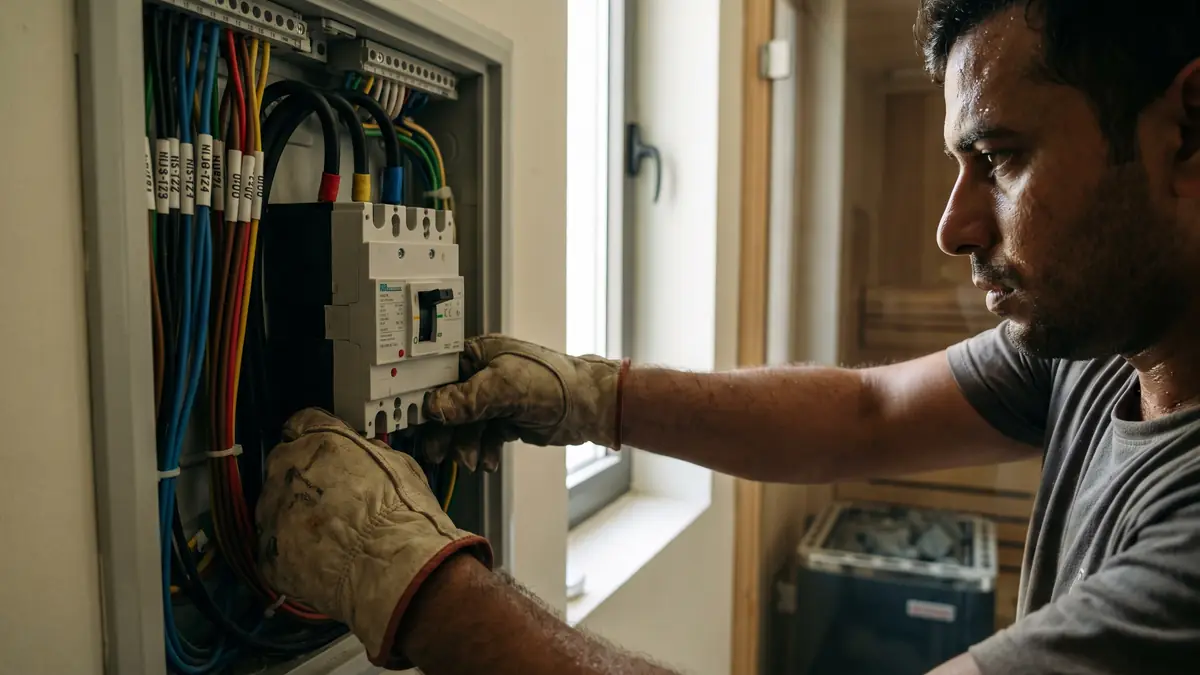
Ten minutes with the DB board open answers the question that decides the timeline: is there spare capacity? We photograph the main breaker rating, count the spare ways, note the existing large loads, and check whether the supply is single- or three-phase. Three outcomes:
- Spare capacity and spare ways. A dedicated circuit and a load-change submission; two to four weeks.
- Spare capacity, no spare ways. A sub-board fed from the main isolator, with the same submission; the sub-board adds AED 3,000 to 6,000.
- No spare capacity. A DEWA load enhancement: a formal application to increase the supply, a DEWA fee based on the increase, sometimes a new cable from the feeder pillar, four to eight weeks. This is common in Jumeirah, Umm Suqeim and Mirdif villas built before 2005, and rare in Dubai Hills, Emirates Hills and Arabian Ranches.
We put the outcome in the concept before anyone orders equipment, and we manage the enhancement where it is needed. The Jumeirah page describes the older-villa case in detail.
The community NOC
Master-planned communities have their own layer. Emaar, Nakheel, Dubai Holding, Damac, Majid Al Futtaim and Dubai Properties communities require a No Objection Certificate from community management for modifications to villa services and for any external structure. The application needs the drawings, an electrical statement and, for a garden cabin or a plunge on the terrace, a site plan and elevations. Approval usually takes two to four weeks and runs alongside the DEWA submission and manufacturing. Outside master communities, in Jumeirah, Al Barsha or Mirdif, there is no community NOC, and only structural or external work needs a Dubai Municipality permit.
Apartments and building management
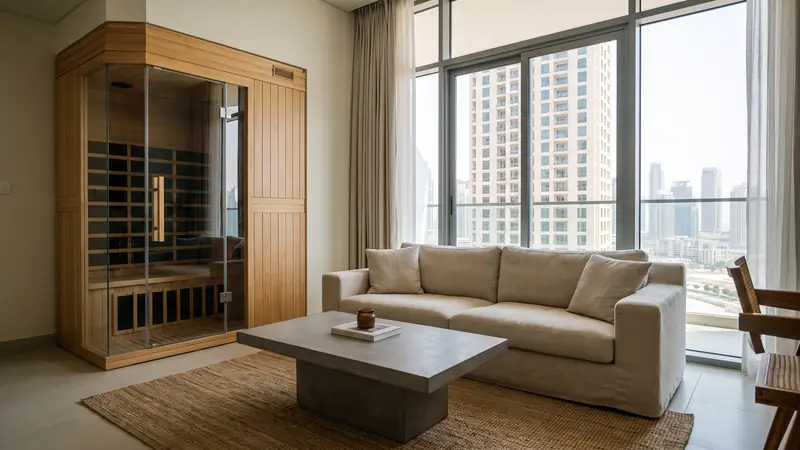
In a tower the building’s own engineer sits between you and DEWA. Building management wants the specification sheet, the circuit statement and a fit-out permit, and for a traditional heater it will ask for the DEWA submission before it approves. Most standard apartments in the Marina and Downtown are single-phase with 60 to 100 A, which takes an infrared cabin and, at most, a 4.5 kW heater; penthouses with three-phase supply take more. The apartment sauna guide explains what each building type tends to approve.
Installation rules that DEWA and common sense agree on
- Heat-resistant SiHF or equivalent cable from the isolator to the heater, because ordinary PVC cable degrades above 70 °C.
- An isolator outside the sauna, within reach, so the heater can be switched off without entering.
- An RCD of 30 mA on the circuit.
- The contactor and control unit outside the hot zone.
- A proper earth on the heater and the metal guard rail.
- No socket outlets inside the sauna or the steam room.
These are on every drawing we issue and are checked at commissioning.
Abu Dhabi and Sharjah
The physics is the same, the portal changes. In Abu Dhabi the submission goes to ADDC, in Sharjah to SEWA, both through registered consultants, both with a single-line diagram and a load calculation, both in two to four weeks. The Abu Dhabi and Sharjah pages cover the local details.
What it costs
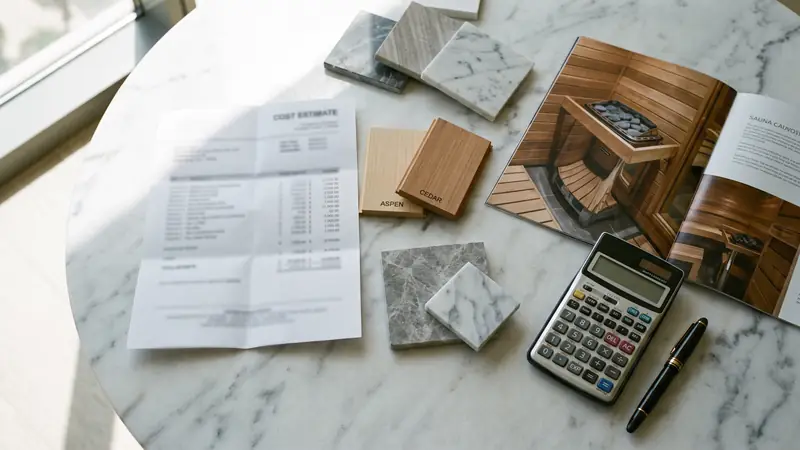
The consultant’s submission costs AED 3,500 to 5,500 and is included in every turnkey price on our pricing page. The electrical package, the dedicated circuit with cable, isolator and RCD, is AED 6,000 to 12,000 depending on the distance from the DB board. A load enhancement, where needed, is quoted after the site visit.
Send a photo of your DB board with the door open and within a business day we will tell you which of the three outcomes applies to your villa.