A hammam is a warm, wet marble room built around a ritual, and there are three rituals to choose from: the Turkish, with a heated central platform under a dome, a kese scrub and a foam massage; the Moroccan, with black soap, a kessa glove and rhassoul clay in a tadelakt room; and the modern, a heated slab and quiet brass in a room designed for a family evening rather than a ceremony. The room follows the ritual, so this guide starts with what the family will do in it and works out to the stone, the steam, the dome and the mistakes that crack marble.
The Turkish hammam
The Turkish hammam is built around the göbek taşı, the heated marble platform in the centre of the sıcaklık, the hot room. You lie on it to warm through, an attendant or a family member scrubs with a kese mitt and covers you in foam from a cloth bag, and you rinse at the kurna basins along the walls, marble bowls fed by hot and cold taps with a copper bowl to pour. Above, a dome pierced with round glass oculi, elephant eyes, that let daylight down in points through the steam.
In a Dubai villa that translates to a room of at least 4 × 4 m, a platform of 1.8 to 2.4 m across heated from below to 40 °C, three or four kurna basins in carved Marmara or Afyon marble, a dome formed from glass-fibre reinforced concrete or plaster on a light steel skeleton and pierced by fifteen to thirty oculi, and a steam generator of 15 to 18 kW that keeps the room at 40 to 45 °C and 70 to 90 % humidity. Ceiling height under the dome should be 3 m or more. Budget AED 350,000 to 900,000, as on the hammam page.
The Moroccan bath
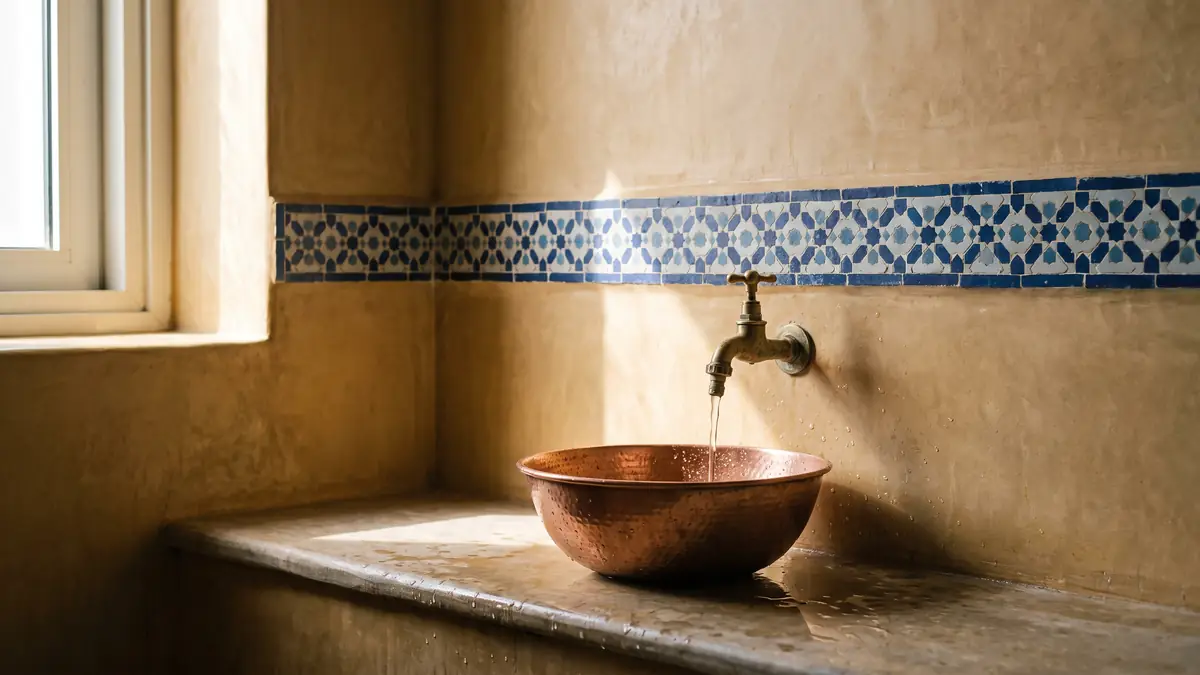
The Moroccan hammam is a sequence of warm rooms, and in a villa usually one: a humid room at 38 to 42 °C with lower steam than the Turkish, finished in tadelakt, a lime plaster polished with stones and sealed with olive soap, with bands of zellige, hand-cut glazed tile, arched niches, a heated bench along the wall and a brass basin. The ritual is beldi black soap left on the skin, a kessa glove scrub, rhassoul clay from the Atlas, and a rinse.
The Dubai version is 3 × 3 m upwards, a heated bench rather than a central platform, a 9 to 12 kW generator, tadelakt applied by a specialist and maintained yearly with soap, zellige in blue, green or ochre, brass or copper basins, and lantern lighting. Sharjah and Abu Dhabi families ask for it most; the Sharjah page describes the pattern. Budget AED 260,000 to 480,000.
The modern hammam
The modern hammam keeps the heated slab and the running water and drops the ceremony. A room of 3 × 3 to 4 × 3.5 m, a slab of 1.6 × 1.2 to 2.0 × 1.6 m in cream travertine or book-matched grey marble, two or three brass basins on the wall, a vaulted or gently pitched ceiling scattered with fibre-optic stars, concealed warm light, and a 12 to 15 kW generator. It is the register most villa owners in Dubai Hills, Al Barari and Jumeirah choose, because it is used every evening by the family and shown to guests at the weekend. Budget AED 180,000 to 450,000.
The heated slab, built so it never cracks
Every register has warm stone, and warm stone cracks when it is built wrong. Our layers, from the bottom up: tanked concrete; insulation board, so warmth travels into the stone rather than the ground; a screed carrying the heating, either electric mats or water pipes laid in loops roughly a hand-span apart; a temperature probe; then 30 mm of honed marble set on a solid adhesive bed, softened at the edges and kept clear of the walls by a compressible strip. The slab has its own thermostat and circuit and is held just above body temperature, independent of the room’s steam. The two mistakes that crack slabs are heating mats laid directly under thin stone with no screed, and stone bedded hard against the walls with no joint.
Steam, humidity and ventilation
A hammam runs cooler and less saturated than a steam room: 40 to 45 °C and 60 to 90 % humidity, with the stone warming the body more than the air does. Marble soaks up heat before it gives any back, so the steam generator is chosen for the volume and for the area of exposed stone; it ends up a size above what a tiled room of the same dimensions would need. Fresh air enters through a filtered grille near the floor, and a fan pulls damp air out once the session is over, leaving the room dry by morning. In an air-conditioned Dubai villa the door must seal, or the humidity migrates into the corridor and the AC ducts.
Waterproofing: the room is a pool
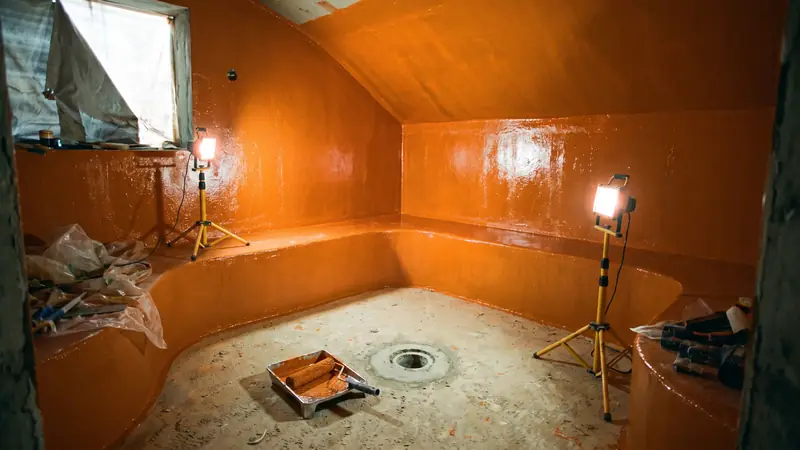
A hammam is full of holes in its waterproofing: cables for the slab, pipes to every basin, the steam nozzle, floor drains, light fittings. Water will find each one. Cementitious tanking on every surface, a bonded membrane over it, flanged seals at every penetration, and a 48-hour flood test before the screed. Tadelakt and marble sit on top of that; neither is the waterproofing layer. Our list of seven steam room waterproofing failures applies to hammams too.
Stone, plaster and brass
Cream travertine, Thassos and book-matched grey marble for the modern room; Marmara and Afyon white for the Turkish, with carved kurna basins; tadelakt in ochre, grey or blush and zellige for the Moroccan. Honed, never polished, so the floor is safe wet. Brass and copper for basins and taps, unlacquered so they patinate; chrome does not belong in a hammam.
Power and approvals
Two loads need their own circuits: the steam generator, usually between 9 and 18 kW and therefore three-phase, and the slab heating at a few kilowatts. Both go into a single load-change application, to DEWA in Dubai, ADDC in Abu Dhabi or SEWA in Sharjah; the steps are in our guide to DEWA approval for saunas and steam rooms. Wet-works changes to drainage need a community NOC in master communities.
Fitting the hammam into the suite
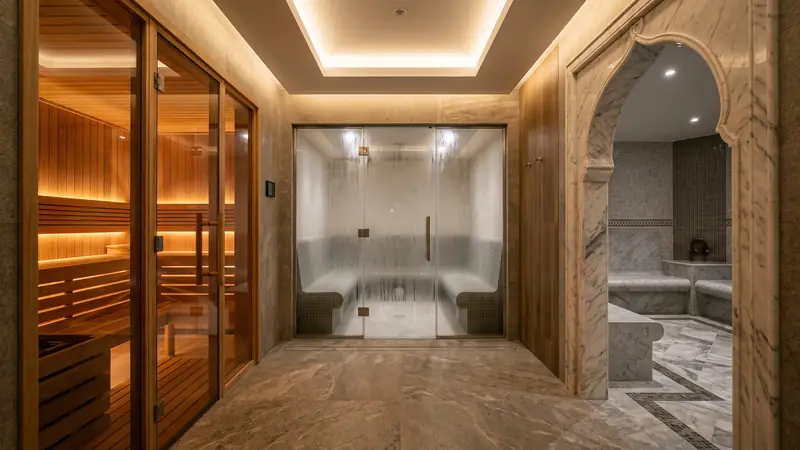
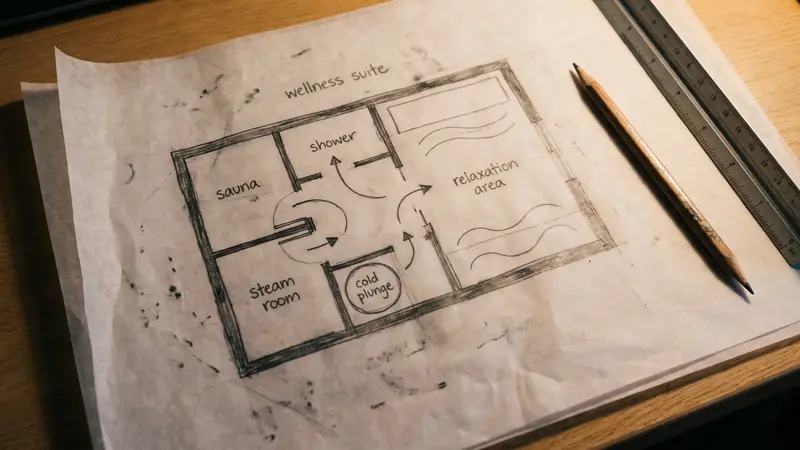
The hammam is the centre of the largest villa suites, with the sauna and the plunge on either side and the recovery rooms beyond; the villa wellness suite layout article draws it. Where the family wants one wet room and one dry room, the sauna versus steam room versus hammam comparison helps decide which.
Tell us on WhatsApp which of the three rituals your family would follow and send a photo of the room; we answer within one business day with the register that fits, the size and a budget band.