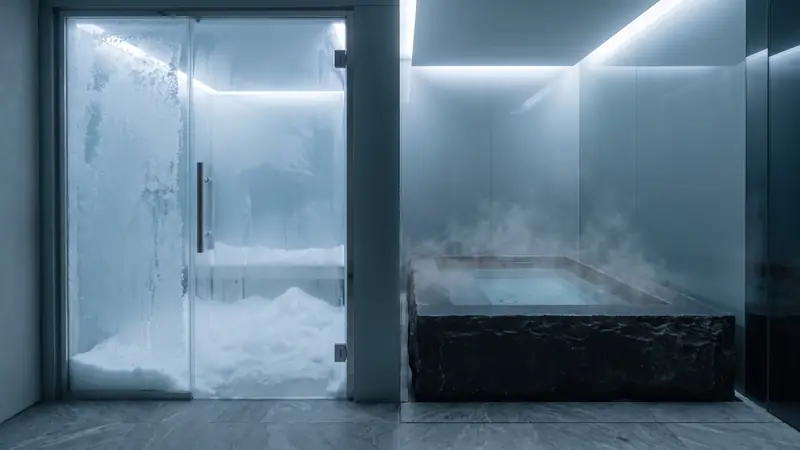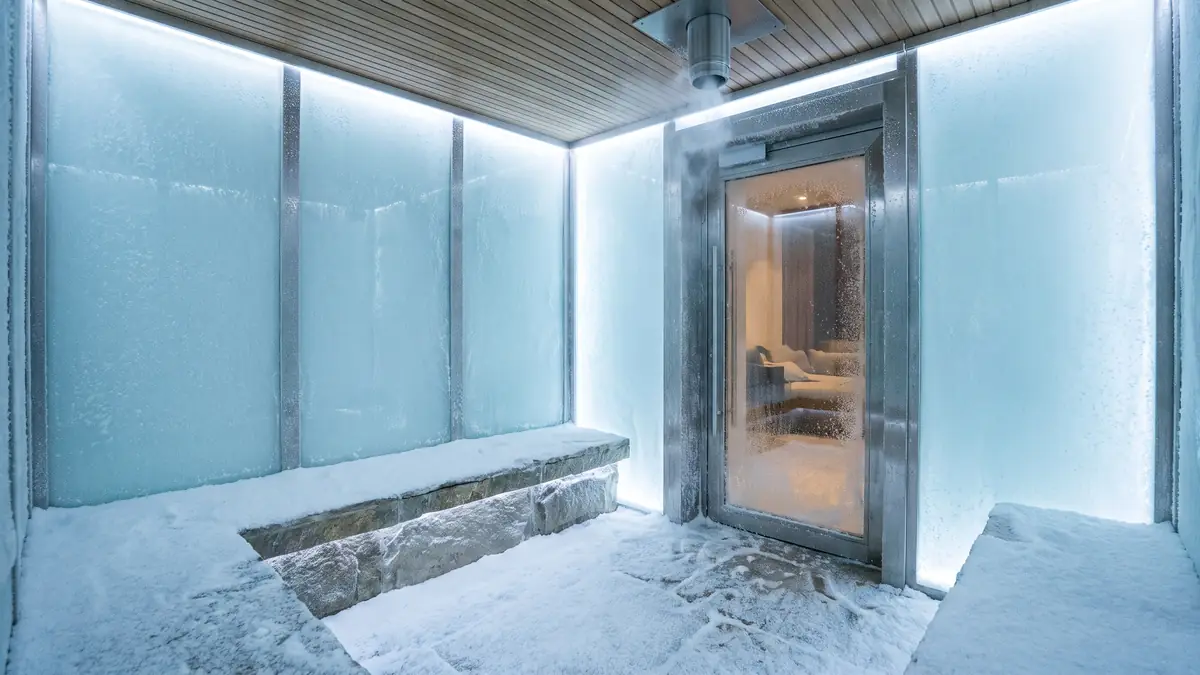
A snow room at home in Dubai costs, indicatively, AED 380,000 to 750,000 turnkey for a villa room of about 6 to 12 m², and roughly AED 900 to 1,600 a month to run in summer. It is an insulated cold cell held at -2 to -8 °C, where a snow generator turns filtered water into powder snow that settles on the floor and benches. Its benefit is a gentle, sociable cold after the sauna that guests and family actually use. This guide breaks down the cost, explains how the snow is made, and is honest about what the room does and does not do. The engineering and packages are on our page about the snow room in Dubai.
Snow room in a house: what it costs
The price depends mainly on the size of the cell, the refrigeration plant and whether the room has an entrance lobby. Indicative turnkey bands for a Dubai villa, confirmed after a site survey:
| Room | Approximate internal size | Guests at once | Refrigeration | Indicative cost (AED) |
|---|---|---|---|---|
| Compact snow room | 2.4 × 2.4 m | 2–3 | about 5 kW | 380,000 – 480,000 |
| Family snow room | 3.0 × 3.0 m | 4–5 | about 7 kW | 480,000 – 620,000 |
| Snow room with an entrance lobby and ice fountain | about 3.6 × 3.0 m, lobby extra | 5–6 | about 9 kW | 620,000 – 750,000 |
These figures cover design and 3D visualisation, the insulated cell and door, the refrigeration plant, the snow generator, drainage for melt, lighting and finishes, the electrical submission and commissioning. They do not include creating a basement where none exists, or major builder’s work to the villa. A hotel snow room is larger, runs longer hours and is priced within a commercial spa scope.
Where the money goes
A snow room looks like a decorative space, but most of its cost sits where you cannot see it.
- The cold cell. Polyurethane panels 100 to 150 mm thick on every face, floor included, with a vapour-tight skin. It is built like a walk-in freezer, then finished inside in stone, resin or backlit panels.
- Refrigeration. A cooling coil inside and an outdoor condensing unit chosen for 45 °C air. This is the line that separates a room that holds -5 °C in August from one that drifts towards zero.
- The snow generator. Nozzles in the ceiling atomise filtered water into the cold air; a controller runs snow cycles, usually overnight, and a defrost cycle each week.
- Drainage and melt. A heated drain and a melt tray, so defrosting never floods the spa corridor.
- The door. Insulated glazing in an electrically warmed frame, which keeps ice off the seal and lets it close properly for years.
- Finishes and light. Benches, wall panels, ice-blue and white LED, sometimes a starlight ceiling.
How the snow is made
The cell is cooled first, well below freezing. The generator then sprays a very fine mist of filtered water into that air. Each droplet freezes before it lands, and the result is loose powder snow rather than ice. The controller tops the room up automatically, so the snow is fresh when you walk in, and the weekly defrost clears any build-up on the evaporator. It is the principle of a ski-slope snow gun, scaled to a small room with a quiet plant.
Snow room benefits, honestly
What users describe, and what we see when we hand a room over:
- A gentle cold. Five to ten minutes in air below zero, barefoot on snow, rubbing a handful on the arms and neck. It feels bracing, not shocking.
- Cold that everyone uses. Guests who would never climb into a plunge, children with supervision and older family members walk into a snow room without hesitation. A cold room that is used every day is worth more than one that is admired.
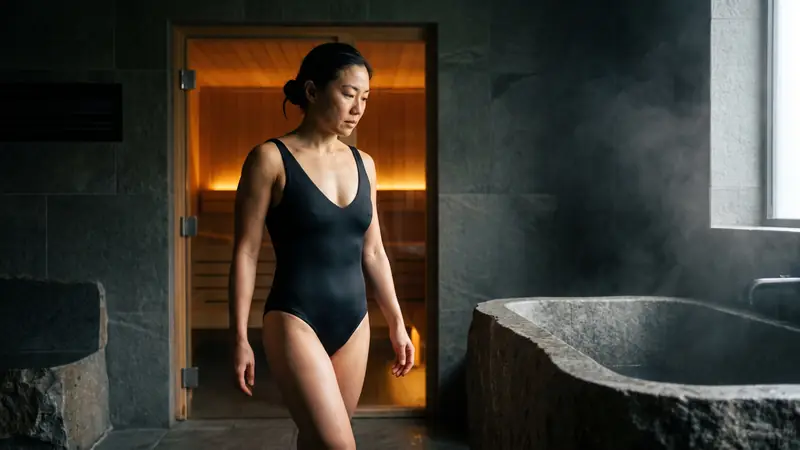
- A better sauna routine. Heat, snow, rest, repeat. The contrast makes the sauna sessions feel shorter and the rest afterwards deeper, which is the reason spas pair the two.
- A room people remember. In a villa or a hotel suite it is the room guests talk about and photograph.
What we do not claim: that a snow room treats or prevents any illness, burns fat, or speeds recovery in any measured way. Research on cold exposure is active and mixed, and most of it concerns cold water, which removes heat far faster than cold air. Anyone with a heart condition, circulation problems or high blood pressure should talk to a doctor before using any cold room. The heat-and-cold routine we give clients sets out sensible timings.
From Antilia to Emirates Hills
The private snow room became a talking point with Antilia, the Mumbai residence that media reports describe as having one among its amenities. In Dubai the idea is less exotic than it sounds: the city already has real snow at its indoor ski slope, and owners of large villas in Emirates Hills, Palm Jumeirah and Al Barari now ask for a snow room when they plan a basement spa. What changes between a statement room and a working one is engineering for the Gulf, above all the condensing unit and the insulation.
What the villa needs
A snow room needs a room with about 2.4 m of clear height plus the insulation, a floor drain within reach, a three-phase circuit for the refrigeration, a route for the refrigerant lines to the outside and a shaded, ventilated place for the condensing unit. Basements, pool houses and larger ground-floor rooms all work. The cell is a box built inside the existing room, so the villa structure is not altered. Apartments rarely qualify, because towers seldom approve an external condensing unit and a three-phase refrigeration load. In master communities the external plant also needs the developer’s NOC, filed with the design set.
Running cost in a Gulf summer
Budget roughly AED 900 to 1,600 a month for electricity from June to September, less in winter. Nearly all of it goes on the compressor, replacing the warmth that creeps in through the walls and around the door. Three things keep the figure in that range: panel thickness, a heated door frame with a good seal, and a condenser in shade with real airflow. A lightly insulated cabin with its condenser in a closed cupboard can cost twice as much and still fail to reach temperature in August. Annual service, with a refrigerant and condenser check before the summer, is part of our maintenance plan.
Snow room, cold plunge or both
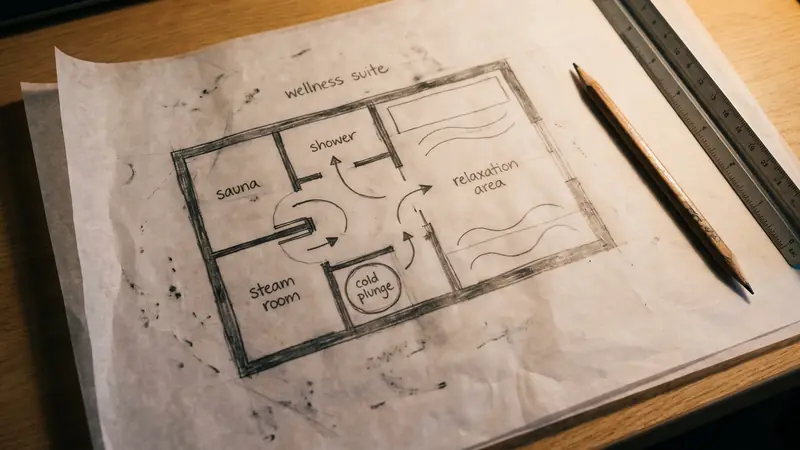
A cold plunge costs a fraction of a snow room and delivers a far stronger cold in a few minutes of water at single-digit temperatures. The snow room is gentler, costs more to build and run, and suits guests and family members who will not submerge. Large suites often get both, so the athletes in the family have their shock and everyone else has a cold they enjoy. The side-by-side comparison is in snow room vs cold plunge, and our layout guide for villa wellness suites shows where each sits in the plan.
How we build a snow room
Fourteen to twenty weeks from signing: roughly a month of drawings, refrigeration calculations and permits, two to three months to make the cell, plant and snow system, and two to four weeks on site. The cell panels, benches and finishes are prepared in our factory in Istanbul, where we have built spa rooms since 1987, and every component is checked, numbered and crated before shipping. Our own crew installs the cell, connects the plant, runs the room down to temperature and makes the first snow with you in it. The room carries a 24-month warranty from commissioning, and the snow room usually sits beside the sauna of a villa wellness suite so plant and drainage are planned once.
Planning a villa spa with snow in it? Message us on WhatsApp with the basement or pool-house plan and a note of where outdoor plant could go. By the next business day we come back with a cell size, a refrigeration estimate and a first itemised budget.