Yes, part of it. A careful self-builder with a garage, a mitre saw and a free month can frame, insulate, vapour-seal and clad a two-to-three-seat sauna and build its benches, and the result can be a good room. What a self-builder cannot do in Dubai is the heater circuit, the DEWA submission or the glass, and the point where most DIY saunas go wrong is not the timber but the ventilation and the vapour barrier. This is an honest account of what is realistic, what it costs in AED and where to stop, and at the end an offer of a free consultation for anyone building their own.
What you will need
| Item | Notes | Cost (AED) |
|---|---|---|
| Timber framing, 50 × 75 mm kiln-dried | for a 1.8 × 1.6 × 2.1 m room | 2,500 – 4,000 |
| Mineral wool insulation, 50 mm | walls and ceiling | 1,500 – 2,500 |
| Aluminium foil vapour barrier and foil tape | sauna grade, not builder’s foil | 1,200 – 2,000 |
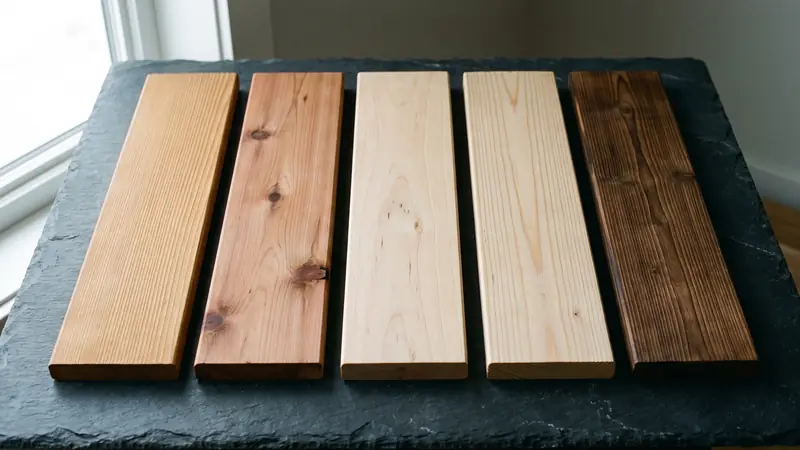
| Thermo-aspen or alder tongue-and-groove, 15 mm | walls and ceiling, 22 m² | 7,000 – 12,000 |
| Bench timber, thermo-aspen 28 × 90 mm | two-tier benches | 3,000 – 5,000 |
| Door, tempered glass 8 mm with frame | bought as a unit | 3,500 – 6,000 |
| Ventilation grilles, extract fan, ducting | 1,200 – 2,500 | |
| Stainless screws, fixings, oil | 316 grade | 800 – 1,500 |
| Branded heater with controls and stones | Harvia, EOS, Tylö, 6 kW | 12,000 – 20,000 |
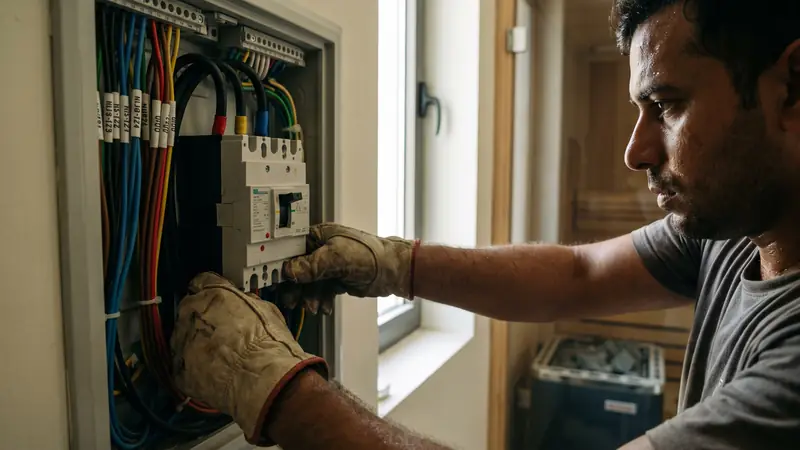
| Licensed electrical work and DEWA submission | not DIY | 10,000 – 17,000 |
Materials for the room come to AED 22,000 to 40,000; with the heater and the professional electrical work, AED 45,000 to 75,000. A built room of the same size is AED 65,000 to 140,000 on the pricing page, so the saving is real if your time is free and the result is good.
Step by step
- Choose the room. A garage bay, a spare room or a garden room with a concrete floor, a ceiling of at least 2.1 m, and a route for a dedicated circuit from the DB board. Ask a licensed electrician to confirm the supply first; the DEWA approval guide explains why.
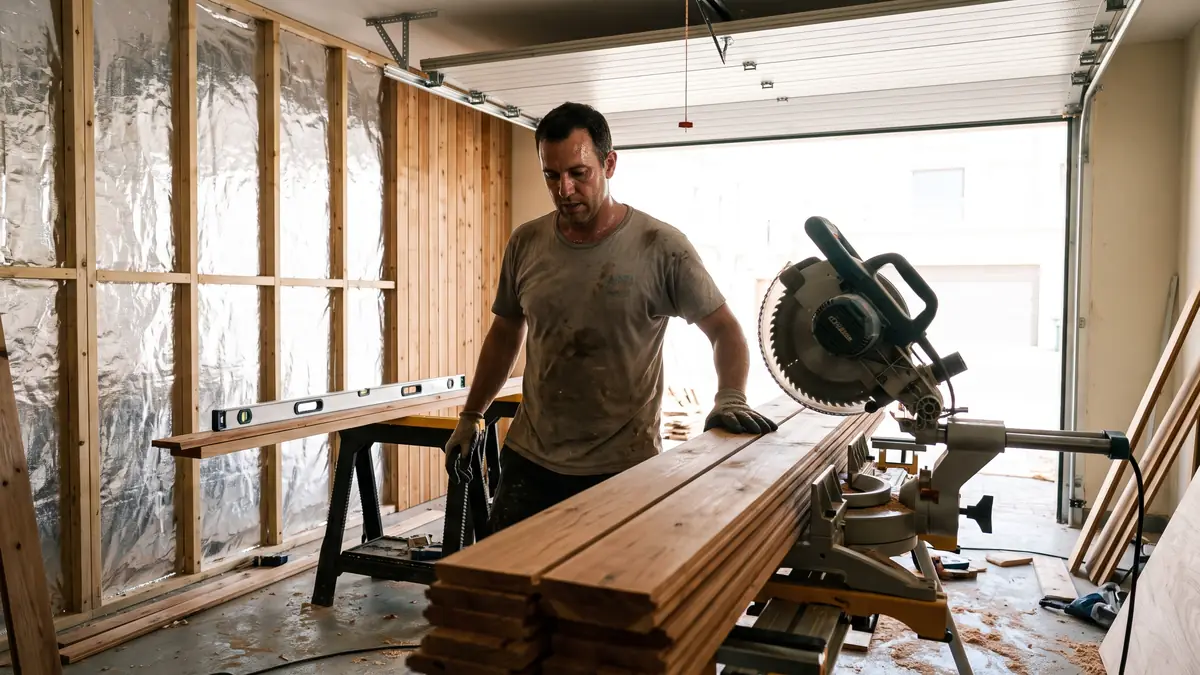
- Frame. A stud wall on three sides, 50 × 75 mm at 600 mm centres, a ceiling frame at 2.1 to 2.2 m, a door opening for a bought glass door. Check square twice.
- Insulate. 50 mm mineral wool between the studs and joists, cut tight, no gaps.
- Vapour barrier. Sauna-grade aluminium foil over the insulation on the warm side, every seam taped with foil tape, every penetration taped, no tears. This is the step most self-builders get wrong, and a torn barrier means mould in the wall within two summers of air-conditioned dryness and sauna humidity.
- Ventilation gap. 20 mm battens over the foil so the cladding has an air gap behind it.
- Clad. Tongue-and-groove thermo-aspen or alder, horizontal on walls, secret-nailed or clipped so the boards can move; the best sauna wood guide explains why not pine.
- Benches. A lower bench at 450 mm and an upper at 900 to 1,000 mm, slats with 8 to 10 mm gaps, rounded edges, a removable upper frame.
- Ventilation. A fresh-air inlet low behind the heater position, from the air-conditioned room, and an extract high on the opposite wall with a fan that can run after use.
- Door and lighting. Fit the bought glass door; use a sauna-rated light fitting, never a domestic one.
- Stop. The heater, the circuit, the isolator, the RCD, the guard rail and the DEWA submission are for a licensed contractor.
Typical mistakes
- Builder’s foil instead of sauna foil: it delaminates at temperature.
- Taped seams skipped: the wall goes mouldy where you cannot see.
- Pine cladding: resin on the bench and gaps by the second summer.
- No air gap behind the cladding: the boards cup.
- An inlet from outside: 45 °C dusty air in July and a heater that never rests.
- No extract: a damp room that smells within a year.
- A ceiling at 2.5 m: heat you pay for above your head.
- A domestic light fitting: melted within a month.
- An unbranded heater from a marketplace: no certification, no cut-out, no parts, and the one thing in a sauna that can start a fire.
Where DIY stops
The heater circuit is a dedicated three-phase or single-phase circuit with heat-resistant cable, an isolator outside the room, a 30 mA RCD and a contactor outside the hot zone, installed by a licensed contractor and submitted to DEWA through a registered consultant. That is the law, it is what your home insurance and your developer NOC assume, and it is not a corner to cut. Glass walls are a specialist installation. Steam rooms and hammams are not DIY projects at all; the waterproofing mistakes article shows why.
If you would rather buy the box and do the rest
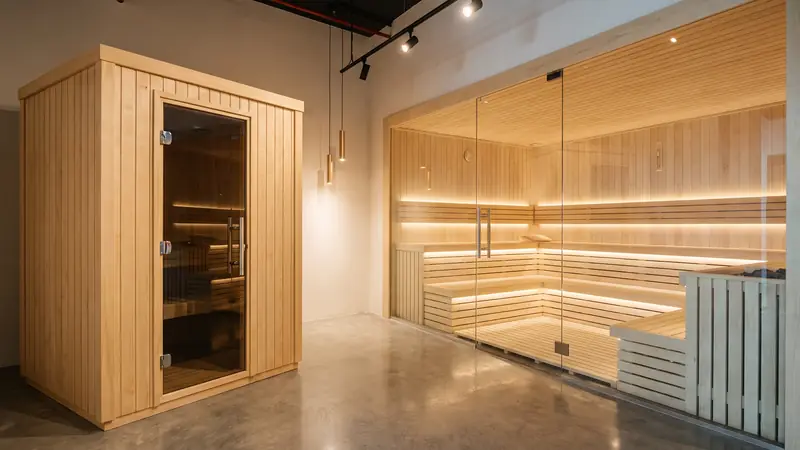
A prefabricated cabin from a European maker, AED 35,000 to 65,000 supplied, gives you a factory-cut kit that a self-builder assembles in a weekend; the prefab versus custom article compares the routes.
Want to try it yourself? We will help, honestly
If you want to build your own sauna, we respect that. In the time between projects our designers offer a free consultation for self-builders: send photos of the space and your plan, and we will tell you what is realistic without special equipment, where the vapour barrier and the ventilation need attention, and what your DB board can take. We will supply a branded heater and controls if you want them, and do the electrical work and the DEWA submission as a stand-alone job. No pressure to hand over the rest.
Message us on WhatsApp with photos of the space and the words “self-build” and a designer will get back to you inside one working day.
This guide is for information only. Working on electrical circuits, pressure vessels, refrigerant lines or structural elements without a licensed contractor can be dangerous and may void your home insurance and your developer NOC. Sauna Dubai is not responsible for the outcome of self-build work.